


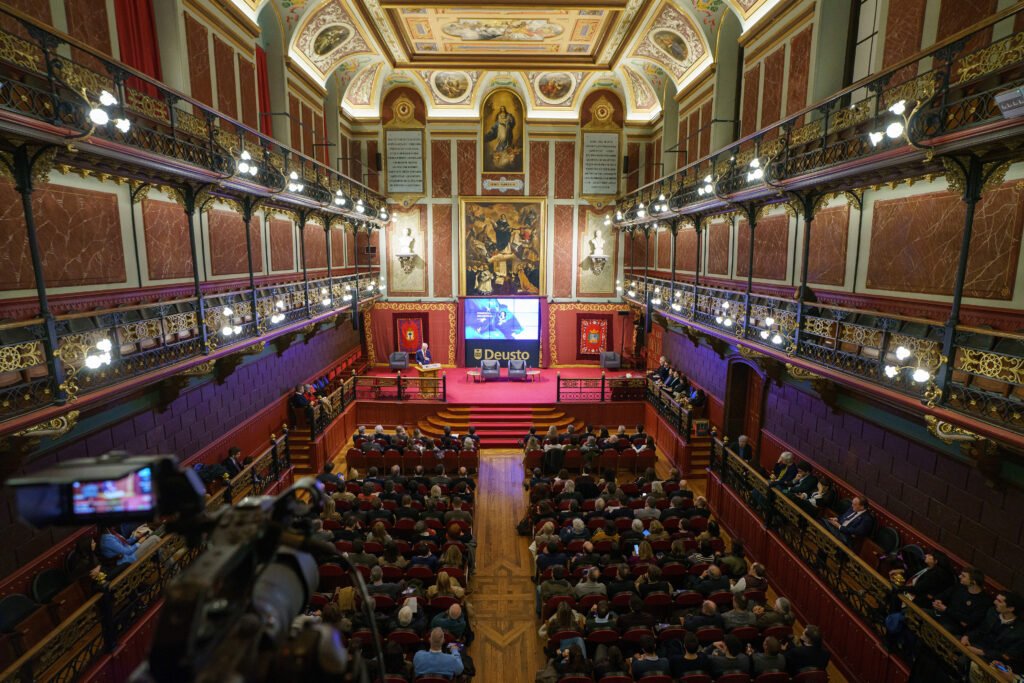
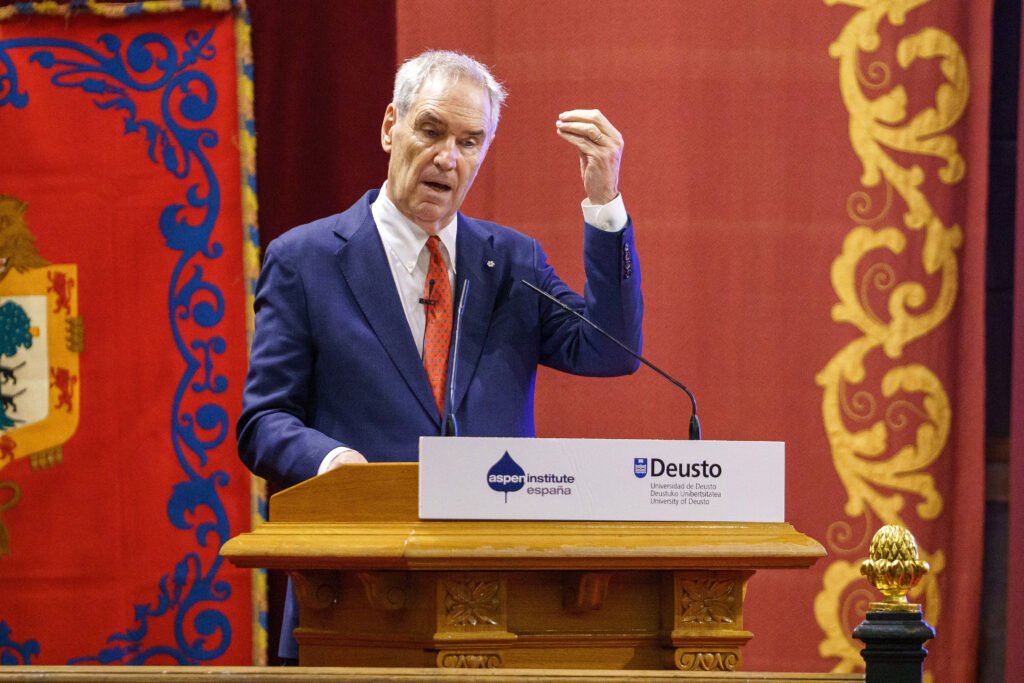
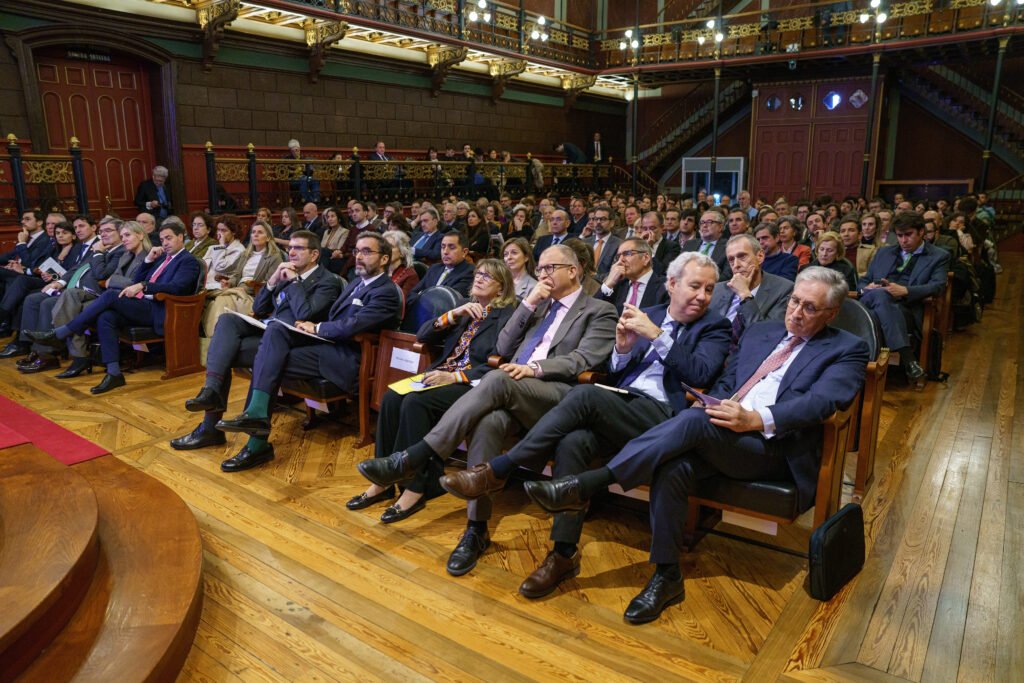
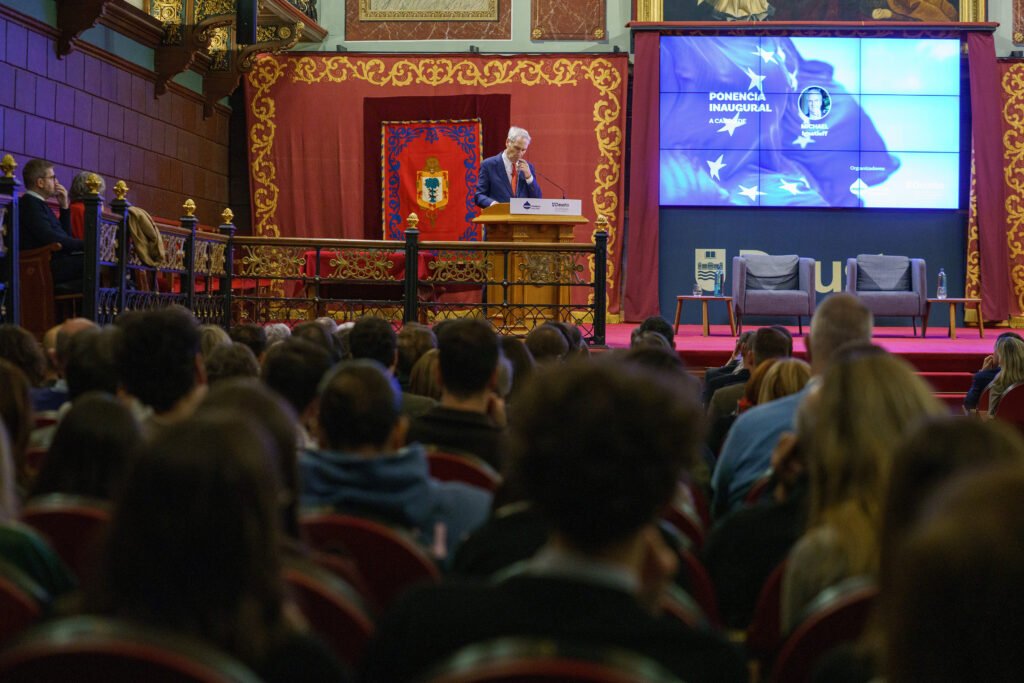
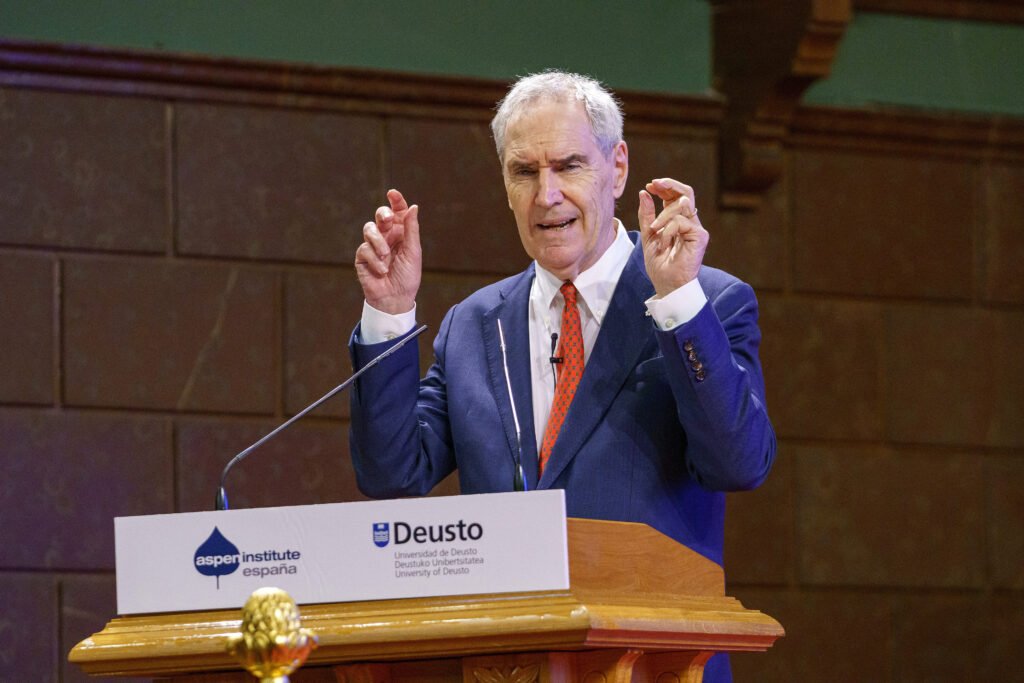
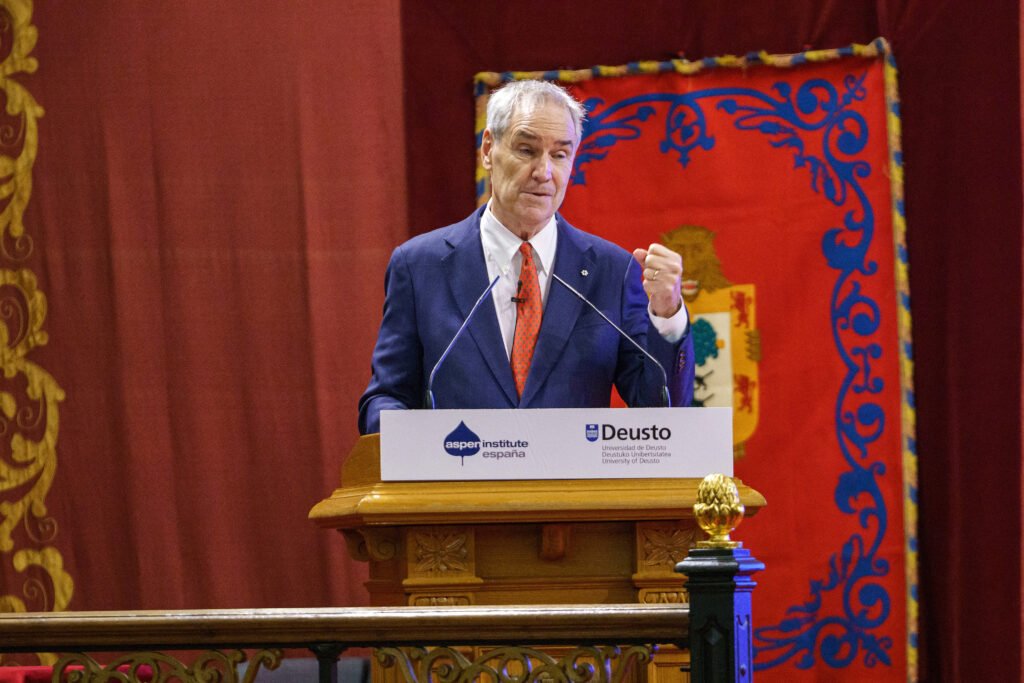
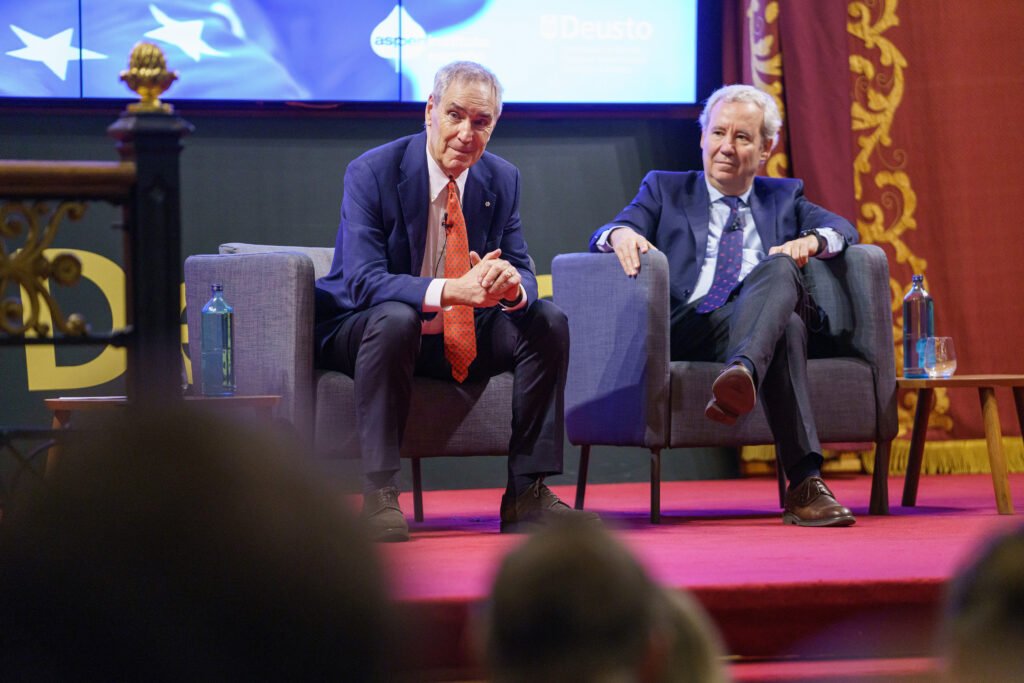
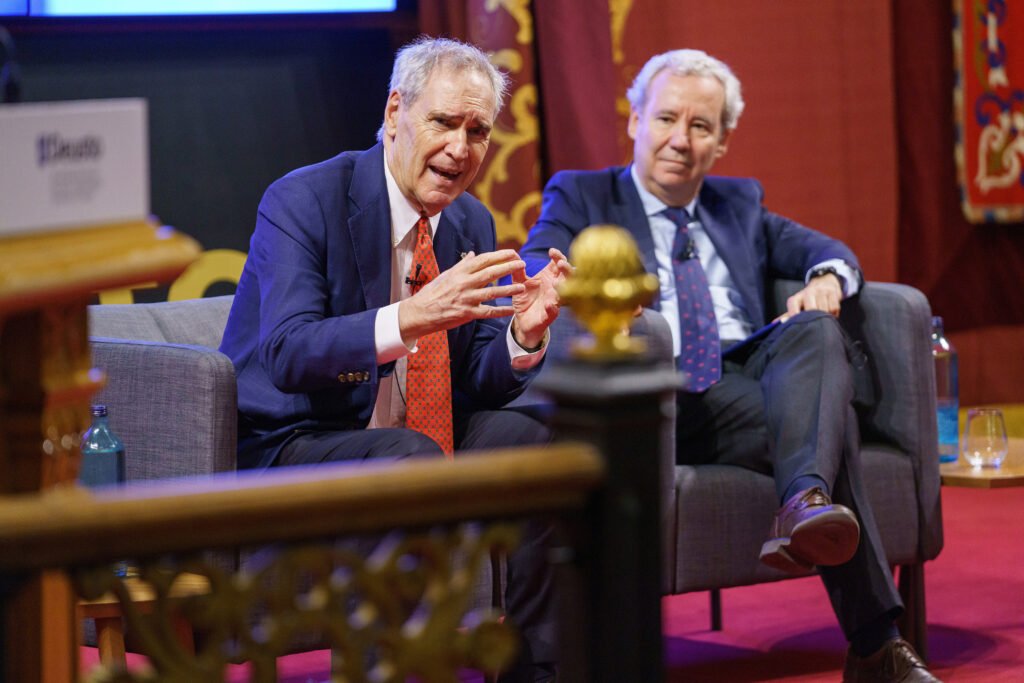
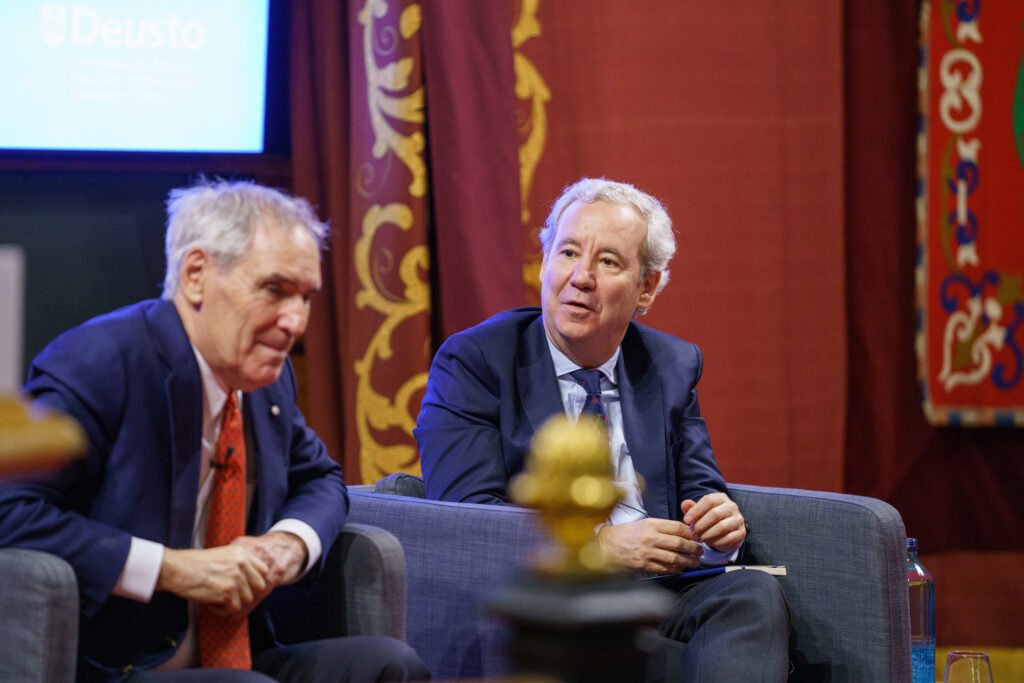
Michael Ignatieff, Professor at Central European University (CEU) and Laureate of the 2024 Princess of Asturias Award for Social Sciences, gave the keynote address at the conference “Geopolitics, Leadership and Values,” organized by Aspen Institute España and the University of Deusto on 19 February 2026.
Thanks to the support of Iberdrola and Kutxabank as principal sponsors, and with the sponsorship of the Bilbao City Council, the Office of the Secretary General for Defence Policy of the Ministry of Defence (SEGENPOL), Euskaltel Fundazioa, and Círculo de Empresarios Vascos.
Bellow you can find the full transcript.
Thanks, first of all, to Jose Maria Areilza, for this invitation, to the distinguished guests with us—President of the Basque Government, Mayor of Bilbao, President of Deusto University—and most of all to the Aspen Fellows, whose company I’ve enjoyed once before.
We have a triple theme—geopolitics, leadership and values—and I’ll say something about each of them. My overall theme is simple: times like these have an overwhelming, even disabling quality. Some periods of change like 1989 felt empowering, but changes of this magnitude—the dissolution of the liberal world order—feel disempowering. Our task, as teachers, as leaders of today and leaders of tomorrow, is hold on to our own sense of agency—the belief that we can shape our lives for the better—and to sustain that belief in everyone around us.
First geopolitics.
As Canadian Prime Minister Mark Carney said in Davos, we are living a rupture in geopolitics, not a transition. Rupture means something has been broken.
What exactly? Trust for one thing. With trust broken between the United States and its European allies, Europe faces a new existential uncertainty. It is not whether the US will abandon its bases in Europe—it still needs them—but whether, in case Russia crosses into NATO territory, the US will fulfill its article 5 commitments. This uncertainty has forced the two European countries with nuclear capabilities—France and Britain—to examine whether their forces can provide the pooled capability to deter a prospective Russian attack.
The rupture is also a break in cultural and historical connection. At the Munich Security Conference, Secretary of State Rubio tried to reassure the audience that America still feels that it is a ‘child of Europe’. Yet a year before, Vice President Vance argued the opposite: that only the American republic, under MAGA leadership, had stayed true to Europe’s founding traditions of liberty. So now Europe doesn’t know whether it can count on the warm reassurance offered by the Secretary of State or prepare for the cold indifference of the Vice President. Both of them are candidates to succeed the President in 2028. Europe can’t afford to wait two more years for an answer.
In 1777, when the Americans had just won their first victory in their war of independence against Great Britain, the great Scottish philosopher and economist Adam Smith, was asked whether the British defeat would ruin the empire. Smith famously remarked “Be assured, my young friend, that there is a great deal of ruin in a nation.”¹ Taking heart from Smith, a historian like me hopes there is a lot of ruin in an alliance. Transatlantic ties that are centuries old cannot be ruptured by one Administration.
But the ruin already achieved will require some rebuilding. America treats allies as competitors and potential adversaries. Deal-making has replaced alliance-building: and deal making is increasingly understood as zero sum: we win, you lose, and transactional, you are a friend today, possibly an enemy tomorrow.
The US Secretary of State may have reassured Europe that the bonds remain, but he waved aside the entirety of the shared legal principles on which European and American unity had been based—to justify the kidnapping of Venezuela’s Maduro, the prospective American claim on Greenland and America’s sidelining of the UN. Europe has become the last defender of a legal order that while honored in the breach brought stability to the international system and gave small states some legal and rhetorical recourse against the power of the strong.
Europe is not just challenged on its Atlantic frontier.
Since Putin’s speech to the Munich security conference in 2007, Russia has become an insurgent power: refusing to accept a sovereign Ukraine on its borders, reconquering Crimea, engaging in grey zone operations to destabilize Western democracy, mapping Europe’s undersea cabling to explore opportunities for cutting off Europe’s digital networks, right off the shores of Spain, by the way; developing satellite capacities in space to plunge its adversaries into the digital dark. Yes, the Soviet regime did probe the Western alliance, but after the Helsinki Final Act of 1975, it became a status quo power, working for stability in Europe. No more.
Then there’s China. Until the advent of Xi Jing Ping, the Chinese appeared to be accepting integration into a global economic order dominated by the US. No more. Under Xi Jing Ping, they have embarked on an aggressive use of economic coercion to extract resources and concessions from weaker states. China is flooding the world with manufacturing exports, while seeking to monopolize critical minerals in Latin America and Africa. The US is scrambling to keep up. Most of all, China remains determined to use force if necessary to reconquer Taiwan, despite the clear desire of the Taiwanese people to remain free and democratic.
To use my Harvard colleague’s Steve Walt’s characterization, we now live in a world with three ‘predatory hegemons’, three nuclear powers who dominate all lesser states in the international system.
These hegemons clearly wish to divide the world into three zones of influence: America dominating North and South America; China dominating East Asia, and a Eurasian zone of influence reaching to Europe’s Eastern Frontier.
If so, three questions follow:
- Is Russia now determined to return to the frontiers it enjoyed under Stalin? If so, peace in Ukraine may only be a prelude to Russian challenges to the NATO frontier.
- If the Western hemisphere comes under the control of a mercantilist and expansionist America, what form of sovereignty can the nations of Latin America, Mexico and Canada maintain if their economic freedom is constrained?
- Will the US accept Chinese control over Taiwan, or will it challenge China’s hegemony over East Asia? If the two predators confront each other in the South China sea, can they keep the conflict from crossing the nuclear threshold?
We don’t know the answer to these questions, but it is a reasonable inference that middle powers like Spain will have to pool their resources with other partners to prosper in a world governed by predatory hegemons. It is also a reasonable inference that spheres of influence are bound to be contested, so they delay, rather than prevent, a moment of direct hegemon to hegemon conflict.
Faced with this geopolitical future, Europeans would do well to avoid two related mistakes. The first would be to fall for the catastrophic fallacy: pessimistic theories which declare the future is already decided and will be cataclysmic. The environmental movement has weakened its influence by indulging in the catastrophic fallacy. Let’s not import the catastrophic fallacy into international relations. We’ve had peace between great powers for 80 years, because nuclear weapons do what they are supposed to do: they make their use ultimately unthinkable. But this does not make mistakes or miscalculations impossible, and so it is vital for the great powers to strengthen regimes of deconfliction and contact, just as it is essential that they agree to some ceilings on weapon modernization and development. Even the most predatory hegemon wants to survive.
The second fallacy might be called the Melian fallacy, i.e. that resistance of the weaker against the stronger is futile. In Thucydides History of the Peloponnesian Wars, the Melians failed to understand this and were crushed and sold into slavery by the victorious Athenians. Thucydides drew the famous conclusion: “the strong do what they will, the weak do what they must.”
You are Europe’s leaders today and tomorrow. Leadership’s task is to see the opportunities that lie hidden, the door of possibility that opens when all other exits close. My mentor Isaiah Berlin was fascinated by ‘the sense of reality’ that a leader like Bismarck possessed. Bismarck’s realism was famously ruthless and cynical, but it was also opportunistic and adventurous. He never resigned himself to the contours of political reality as it was. Rather, he took responsibility to change those contours and to realize possibilities that others did not imagine. In Bismarck’s case, it meant embarking on a course of blood and iron that led to Germany’s historic reunification in 1871.
For leaders in countries like Spain, living in a world of three predatory hegemons, it’s vital to conserve a ‘sense of reality’ free of the Melian and catastrophic fallacy. This means preserving a faith in sovereign agency and capability. For Europeans in business, politics, the law and education, the challenge is to convince our students, partners, members, that we have not lost the capacity to be agents, persons who shape their world.
All of the obstacles—political, military, economic—might be grouped under one heading. The challenge in each domain is to find a way to team up, with partners even with competitors, to pool capabilities in order to maximize power, with a view to giving Europe the sovereign capabilities to protect the identity and the values common to all.
Strengthening European common purpose is not going to be easy. If trust across the Atlantic has been ‘ruptured’, trust within the alliance and within Europe is also under strain. Suddenly it’s every nation for themselves. One example: Spain is a member of NATO but has stood apart from the commitment to increase defense expenditure. Spanish voters are bound to ask how Spain stays in the club if it doesn’t pay its membership dues.
Another example: Hungary won’t break its energy dependence on the Russians and when Orban says he’s for peace in Ukraine, he means peace on Putin’s terms. Another example. Even in the face of the Russian threat and American withdrawal, however, the French and Germans cannot agree to build a joint European fighter together.
Elsewhere, the mood in Europe is more robust. In the Baltic states—I was in Vilnius two weeks ago—defense expenditure there is north of 5% of GDP and the whole Baltic region, together with Finland, Norway and Sweden that share borders with Russia are turning themselves into ‘porcupines’, convinced that small as they are, they can actually deter the Russians from an expansionary adventure. Europe as a whole need to stop seeing the Russian problem on its borders through parochial national lenses and come to a common position that there is a threat, and it must be deterred by joint effort.
Europe has pooled technological capabilities before, with spectacular success. Think of CERN, the particle accelerator that crosses the borders between France and Switzerland and has made Europe the world center for particle physics; think of Airbus, a pan European collaboration that has made Airbus a rival to Boeing.
If Europe can scale itself up at CERN and Airbus, it can do so on defense, but it means pooling capabilities, not hoarding them in sovereign enclaves that grow weaker not stronger when they protect their own.
There’s a similar story in the economy. Mario Draghi has been calling for a single European capital market, a single market in financial services. Europe must find mechanisms to aggregate and invest its capital in the technologies of the future. A recent academic report has pointed out, mid-sized economies face insurmountable obstacles in independent frontier AI development. Right now, the US controls 75% of global compute capacity, China 15% and the EU 5%. It’s not that Europe lacks great computer scientists. 87% of the most cited AI scientists originate from outside the US and China, many of them from Europe, and it does not lack some good AI companies, Mistral being one, but it does lack the capital to create the computing capacity to run large language models. The costs of dependency on US and Chinese AI technology are rising: data theft, service restrictions, withholding new technology, embedding of values into the technology that are antithetical to European principles, and mercantilist retaliation in trade.
In a mercantilist era, predator hegemons will use its political power to reinforce its economic power and punish and inhibit rivals. Yet the predator hegemons’ economic power is not unlimited. According to the Financial Times, the three hegemons account for barely 30 percent of global imports, while middle powers account for 40 percent, and most of them are in Europe. It’s time for Europe and its Latin American and Asian partners to build free trade alliances that multiply the leverage of that 40 percent market share.
At the same time, Europe needs to take care to allow its digital dependence on the US to compromise its sovereignty. Let me cite just one example. Two thirds of all euro dominated transactions in Europe are processed by two American companies, Mastercard and Visa. Thirteen countries—including Spain and Austria—have no nationally controlled digital clearing system, for digital and in store transactions. They’re dependent on Mastercard and Visa. If Mastercard and Visa are ordered by US authorities, they can shut a European citizen out of all use of his credit cards.
This example conveys a larger message. Europe cannot survive as a sovereign economic and political actor in a world of predatory hegemons unless and until it can deter predators from using technology to coerce its own citizens. It can’t do this, in turn, unless it equips itself with the capacity to raise and pool capital at scale across 27 separate regulated markets, to channel state resources towards strategic development of AI capacity, military defense, common infrastructure both physical and digital.
Doing so is politically difficult, especially when parties on the right are adamantly opposed to further centralization, and have persuaded substantial numbers of voters, including here in Spain, that more power to Brussels threatens the authority, traditions, dignity and unity of the sovereign state.
It has been a paradox at the heart of the European project itself that only if sovereignty authority is vested in its common institutions can the sovereignty of all be protected and enhanced. This was true in the Cold War era.
Today, defenders of Europe need to change the way their publics think about this issue. If enhancing Europe’s sovereign capacities is defined as a zero-sum gain in which Europe gains and Spain loses, the anti-European right can only win.
The right path is not to drain sovereignty from Spain upwards to Brussels and some European super state, but to empower Europeans at the ground level of the economy and civil society: to make it easier for Europeans, right across its regions, to do business together, to pool resources, to invest in each other’s inventions; to ensure, for example, that it is easy to establish a business in Spain; that Spain has access to enough electrical power, and that European grid systems are integrated so there are no catastrophic failures, as there were earlier this year, and that Spanish entrepreneurs have access to big pools of capital the way American entrepreneurs do; that Spain can count on Frontex and other European institutions to help it police its frontiers and guarantee a steady stream of legal migrants, while shutting the door to illegal migration. So the task of a Spanish politician with a vocation for Europe is complex: to safeguard Spanish sovereignty while also arguing courageously for collaboration, on regulation, energy, military procurement, and migration so that Spain can remain as rich and successful as it has been since it joined the European Union forty years ago.
I’ve said something about geopolitics and something about leadership, and it all comes down to what leaders have to do: to convince their people they are not helpless pawns in a game played far away, but on the contrary, democratic actors with real power to control and shape their future.
Before I close, let me say something, about values. For values unlock motivation. Why do we care that Europe survives and prospers, why do we care that European democracy turns its back on authoritarian illiberalism and fear of the other?
Sometimes you only discover what you really, truly care about when somebody tries to take it away. Sometimes it takes a threat to awaken you to the price of loss. Sometimes, it takes an adversary to remind you who your friends truly are.
We are in such a situation today, where everything we have valued and built in Europe over 80 years is being challenged.
We need to understand that we are facing an ideological counter-revolution, backed by the state power of the world’s most powerful nation: a revolt against the multicultural society, against tolerance and acceptance of the stranger, a revolt against equality for all races, classes and genders, a revolt against international solidarity, a revolt against international law, a revolt against everything, in other words, that Europe of the 21st century has stood for. Counter-revolutions concentrate minds. They make it clear what values made us who we are, what values we must defend, and what adversaries must be defeated.
When you know what you’re up against, you know what you stand for. When you truly know what you’re fighting for, you can win.